
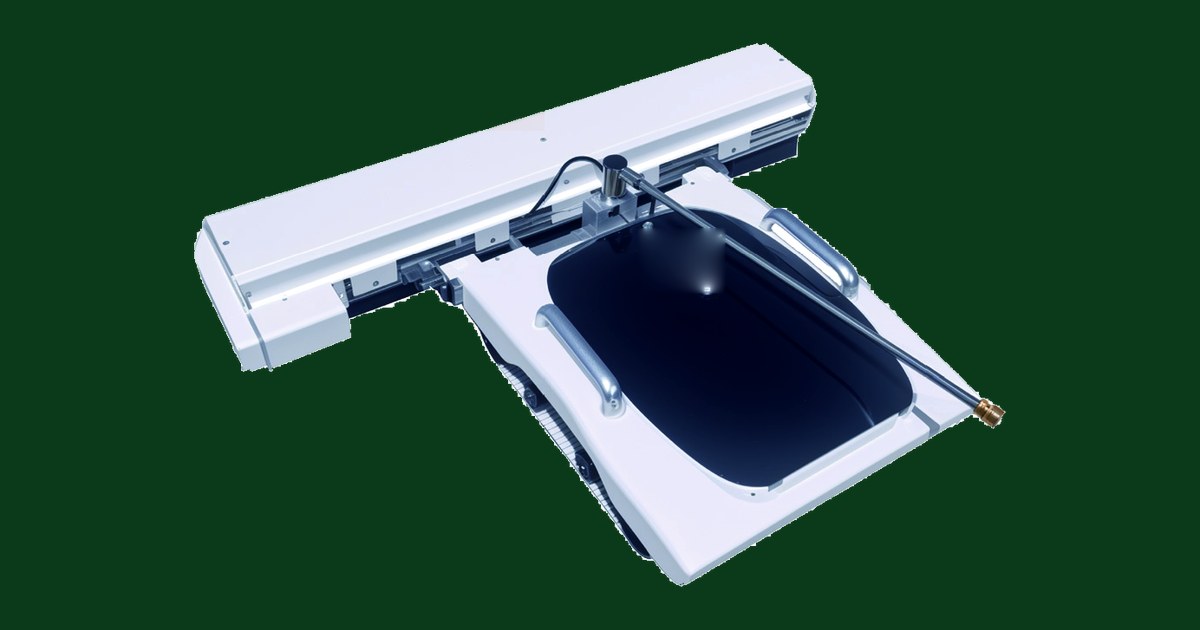
The five robots in the SiRay range share most of their specification. All of them are IP65, all of them work from -20 to 60 ℃, all of them clear dust, oil stains and bird droppings, and all of them carry a one-year warranty with a six-year design service life. Comparing them on cleaning rate alone tells you almost nothing, because the rate is not what stops the purchase.
First: how steep is the array
Maximum operating inclination is the hardest limit in the range, and it runs from 10 degrees on the ASR102 to 30 degrees on the SR203. In between sit the SR102 and SR202 at 15 degrees and the SR103 at 20 degrees.
This is worth taking from the site survey rather than from the brochure. A flat ground-mount plant leaves every machine in the running. A hillside with terraced rows rules out the ASR102 immediately. If you are not sure, measure the fall across the steepest row before you shortlist.
A useful side effect: the higher the inclination a machine is rated for, the more capable its track drive has to be, which is why the 3rd-generation machines exist as a separate step rather than a single chassis with a bigger battery.
Second: total machine weight
Total weight with battery and roller brush fitted runs from 32.5 kg on the SR102 to 44.5 kg on the SR203. The 12 kg spread is not evenly distributed - it is almost entirely the second brush, plus the taller chassis the 30-degree machine needs.
Weight matters for two reasons. It decides how many people are needed to move a machine to the next row, and it decides how many hours the battery can hold up under a load. The twin-brush machines drop to 5 hours of endurance from 8, because two motors are drawing power at once.
Third: one brush or two
The SR202 and SR203 carry twin roller brushes; the other three carry a single brush. Two brushes cover a wider module row in a single pass, and the twin-brush chassis steps over a larger gap: 300 mm on the SR202 and 400 mm on the SR203, against 200 mm on the single-brush machines.
So the brush count is really two decisions wearing one hat. How wide is one row, and how big is the frame gap between rows. Older arrays with wide modules and a large gap between the row frames are where the twin-brush machines earn their extra weight.
Then: who drives it
With slope, weight and brush count settled, the last question is operational rather than technical. The ASR102 is the only machine that runs unattended - RTK navigation, night operation, breakpoint resume and a charging station - and it is the right choice when supervising the plant is a full-time job. The four SR models are cheaper to deploy and are the right choice when one operator can cover the array comfortably from the ground.
The full comparison table, with cleaning efficiency, daily capacity, weight, inclination and brush count on one screen, is in the cleaning range comparison.